Guide · Choosing an agency
How do you choose an SEO agency?
Choose the agency that keeps your accounts and your content in your name, puts in writing what it delivers each month and measures the leads you receive, not just rankings. Lists of questions to ask are everywhere. For each of the ten, this guide also gives you the answer that should reassure you and the one that should send you out the door, with a printable checklist to compare the agencies you meet in Quebec.

By François Painchaud, founder and president of KasvuPublished · Reading time: 11 minutes
In short
- Google Search Console, Google Analytics, your Google Business Profile and your content must belong to you from day one.
- A serious proposal names what is delivered each month: pages, fixes or hours.
- A result is a lead you receive. A ranking or a visit is not one.
- Ask where the links come from: bad links stay attached to your site long after the agency is gone.
- No one can guarantee a #1 ranking. If an agency agrees to one, run.
What should you know before meeting an SEO agency?
Come with three things: the services you want to sell more of, the territory you serve and what a new customer brings you. Without them, the agency can’t choose the right searches, and you can’t judge whether its proposal makes sense.
Also check who holds your access today. Search Console is the free tool where Google shows how it sees your site and which searches it displays it for. If no one at your company can open it, or open the company’s Google Business Profile, fix that before you sign anything: you’ll negotiate knowing what you already own.
Have one page of your site checked before the meeting, too. Our free SEO checker reads it the way Google would and flags what keeps it from being found. You’ll know what to ask the agency, and you’ll see whether it finds the same problems you did.
For the budget, our guide how much SEO costs in Quebec gives the prices published by Montreal agencies and what makes them vary. If your customers are local, also read our guide on local SEO and your Google Business Profile: part of the work can be done on your side.
The 10 questions to ask, and the answer to require
1. Who will own the accounts and the content?
You. Search Console, Google Analytics and your Google Business Profile are created in your name, and the agency works in them with its own access. The content published on your site belongs to you as well, and the contract should say so.
We regularly see the opposite: the agency creates Search Console and Google Analytics in its own environment, then gives the client access. The day the client leaves, they lose their accounts and their entire history, and the next team starts over without knowing what was working. We have even seen agencies have the links they had obtained for a client removed after the engagement ended.
- Good sign
- The accounts are opened in your name, and the agency comes in as a guest.
- Red flag
- You’re promised “access” to accounts the agency created on its side.
2. What do you deliver each month?
A good answer can be counted: a number of pages written, fixes made on the site or hours worked. Also ask which pages will be worked on, and in what order. The pages that sell are your service pages. A plan that doesn’t name them may bring you visitors, rarely customers.
- Good sign
- A list with numbers, and your service pages named in the plan.
- Red flag
- “Ongoing optimization,” or blog posts every month with no word on what they lead to.
3. How do you measure results?
In contact requests that come from Google: calls and forms, counted in your own accounts. The complaint we hear most often from small businesses switching agencies fits in one sentence: “I can’t see what it brings me, in dollars.” A report full of rankings and traffic curves doesn’t answer that question.
Google, in fact, suggests asking any SEO that exact question: “How do you measure your success?”
The same month, two reports
Rankings reportOctober
- 2,840
- visits from Google
- 8.4
- average position
- 312
- keywords ranked
Leads received: the report doesn’t say
Leads reportOctober
- 14
- calls
- 9
- forms
Pages the leads came from
- Roof replacement13
- Roof repair6
- Gutters4
23 leads, each tied to its page
- Good sign
- A report that counts calls and forms, page by page.
- Red flag
- A report that stops at rankings and visits.
4. Where will the links come from?
Links from other sites to yours still count, and this is the part of the job where shortcuts are most tempting. Google’s spam policies target buying and selling links to improve rankings, as well as automated programs or services that create them. A site that violates them may rank lower, or not appear in the results at all.
To be frank, we have rarely seen a site outright penalized: most of the time, Google simply ignores those links. What we often see are clients who arrive with low-quality links whose clickable text repeats the same sales phrase everywhere, something like “dentist” followed by the name of the city. That past complicates all the work that comes after, and it stays with you after the agency is gone.
At Kasvu, we write to the sites where a mention would make sense ourselves, with a proposal tailored to each one.
- Good sign
- Examples of links obtained for other clients, and how they were obtained.
- Red flag
- A guaranteed number of links each month, at a fixed price.
5. Who writes the content, and how much of it is AI?
Google doesn’t prohibit AI in writing. Its rules target something else: using these tools to generate many pages without adding value for readers. It also asks you to focus on accuracy, which means checking what the tool wrote before publishing it. And, of course, to create content that has value for the reader, not content made to climb the rankings in Google.
The problem didn’t start with AI. Whether a text comes from a tool or from a freelancer on the other side of the world (common in Quebec), it gives itself away with the same flaws: words and turns of phrase that no one in your trade uses. Your customers can tell from the first line.
At Kasvu, we follow strict writing rules. Every text is reviewed in-house by the specialist on the account and by the account manager, for quality, consistency and the vocabulary of your trade. You then review it if you want, and we keep a copy of every version of the pages.
- Good sign
- A named person reviews every text, and you can read it before it goes live.
- Red flag
- No one can tell you who checked the facts about your trade.
6. Who will do the work?
The person you meet isn’t always the one who works on your site. Ask who you’ll talk to when a question comes up, and what is outsourced: writing and links often are. There’s nothing wrong with that, as long as you know and someone answers for the result.
With us, all the work is done in-house. How we work is detailed on the page for our SEO agency.
- Good sign
- Names, roles, and subcontracting disclosed.
- Red flag
- “Our team takes care of it,” with no one to talk to.
7. What will you change on my site, and will I know?
Google suggests this question almost word for word: “Will you share with me all the changes you make to my site […]?” It’s your site, and you remain responsible for what’s on it.
Also ask how the site is built. In October 2026, we were shown a site an agency had just delivered, built with an AI tool. It was a single-page application: all the content was injected by JavaScript into the visitor’s browser instead of being written into the page itself. We checked three times before believing it. In principle, Google can run these scripts, but later, when its resources allow, and not all robots do. Here, the finding was clear: the site was invisible to Google, with not a single page indexed. The client had paid for a new site that no one could find, and no one had told them.
François has seen many stories like that one since he started on the Web in 2002. They explain why so many business owners are wary, and that wariness is justified.
- Good sign
- A written list of every change, with its reason.
- Red flag
- “It’s technical, you don’t need to worry about it.”
8. What do you do about AI answers?
Besides searching on Google, your customers now put their questions to ChatGPT or Perplexity. Google itself increasingly answers with its AI Overviews and AI Mode. The goal shifts a little: on top of earning a click in a list of links, it’s about getting the AI to cite and recommend your business.
Yes, this can be worked on, and we do it. The work rests on authority and consistency: a business that other sites talk about, and whose information is the same everywhere. Like the rest of SEO, it takes time, depending on the state of your site at the start.
Be wary of magic formulas, though. For its own generated answers, Google is clear: “There are no additional requirements to appear in AI Overviews or AI Mode, nor other special optimizations necessary.”
- Good sign
- The agency explains in plain words what it does, and why it takes time.
- Red flag
- An “AI” package sold separately, with no way to say what it adds to good SEO.
9. How long is the commitment, and what happens if I leave?
A minimum commitment is defensible: it takes time to fix, publish, then see how Google reacts. At Kasvu, an SEO engagement lasts at least 12 months, is billed monthly and ends with 60 days’ notice. That isn’t a market rule, and other agencies offer shorter terms.
Ask in writing what you keep when you leave: the accounts, the content, the pages, the links. With us, everything stays yours, and you carry on with or without us. A client who is free to leave only stays if it’s worth their while.
I recommend Kasvu Digital to everyone for consulting services related to our website’s search engine optimization […]. François and his team are very professional, and it is a pleasure to discuss strategy with them. Thank you again for your support and collaboration over the past 7 years!
Translated from French
 Sebastian StrozynskiGeneral Manager, PharmaCos Machinery
- Good sign
- A clear term, a known notice period, and a written list of what you keep.
- Red flag
- Automatic renewal with no clear notice, or access held back when you leave.
10. In what case would you tell me SEO isn’t right for me?
This is the most revealing question. We turn down an engagement when no one searches for that kind of product or service. A new product isn’t an obstacle in itself: the searches can come. But if no one opens Google to look for that type of product, SEO won’t change your sales, and we don’t take it on. We also turned down a restaurant chain well known in Quebec. It already showed up in local searches and for its own name, and we couldn’t see what more we could bring it.
When doubt remains, we suggest a test: about three months of Google Ads in the search results, on a small budget. If the ads bring in leads, people really are searching for your service, and SEO is worth the investment. If not, you’ll have learned it without committing for a year.
Above all, the test shows which keywords bring in real customers. SEO takes longer, and getting the keywords wrong is expensive: a whole strategy built on searches that bring visits, but few or no new customers. In a case like that one, starting with Google Ads gives you a clear advantage.
- Good sign
- Specific cases where the agency said no.
- Red flag
- “SEO is right for every business.”
Can an agency guarantee a #1 ranking?
No. Google puts it in writing: “No one can guarantee a #1 ranking on Google.”
When a prospect asks us for that guarantee, we tell them we aren’t the agency they need. We add that if another agency agrees to it, they should run, then rethink their whole approach.
The same caution applies to timelines. An agency that announces a date without having looked at your site is selling a guess. What it can give you, according to Google, is what an audit should provide: “realistic estimates of improvement, and an estimate of the work involved.”
Agency, freelancer or in-house: which to choose?
| Option | Fits when | Watch for |
|---|---|---|
| Agency | You want to hand the site, the content, the links and the tracking to a team | Who really does the work, ownership of the accounts and the content |
| Freelancer | The site is healthy and you mainly need content or an expert eye | Availability, backup, technical fixes |
| In-house | Someone on your team can devote time to it every week | Training, the time actually given, access to a developer |
Should you choose an SEO agency near you?
Not necessarily. SEO is done remotely, and we serve clients across Canada. We have also served clients in the United States and Europe. What matters is that the agency knows your market. Quebec is a place apart: the words your customers type here aren’t always the ones used in France, and customers who also search in English call for pages in both languages. Your trade matters just as much. A law firm and a manufacturer have neither the same searches nor the same constraints.
The checklist to bring to your meetings
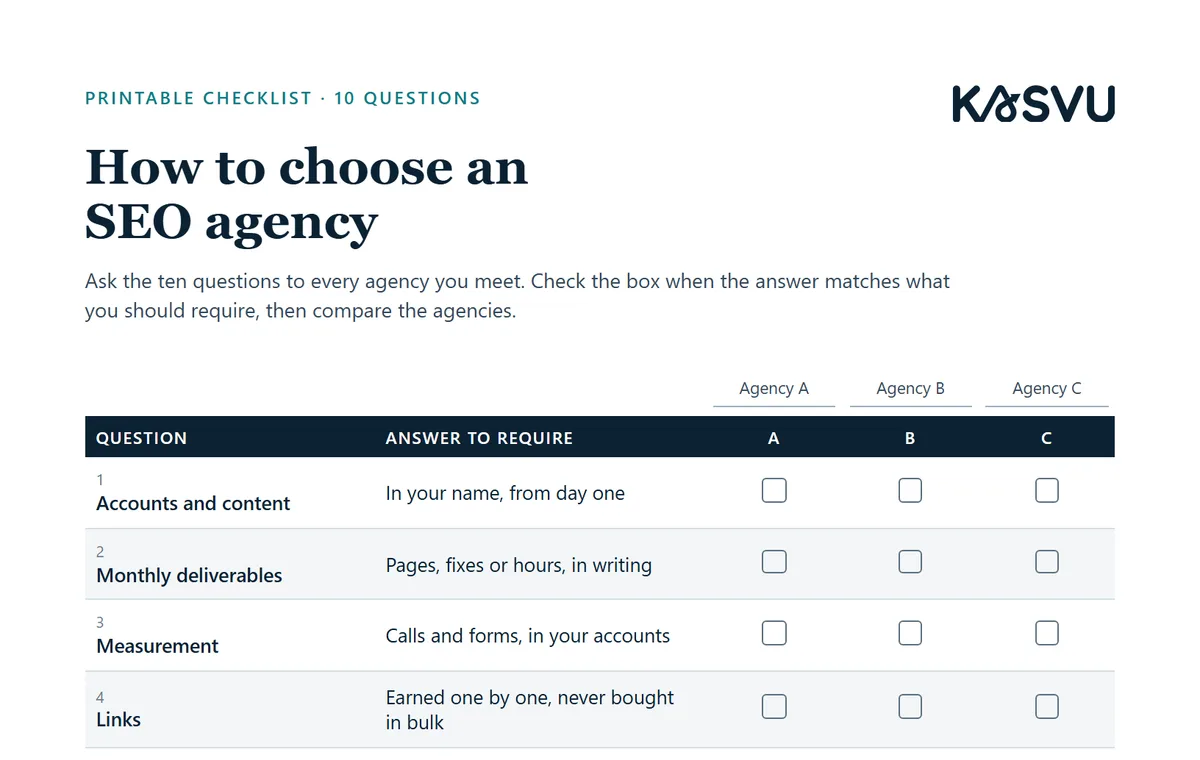
A vague answer counts as a “no.” Download the checklist (PDF), check the box when the answer matches the good sign, and ask for written answers about the accounts, the deliverables and the end of the contract. If you’re also comparing advertising agencies, the same method works for choosing a Google Ads agency.
Sources
- Google Search Central, “Do you need an SEO?” · consulted November 28, 2026
- Google Search Central, spam policies for Google web search · consulted November 28, 2026
- Google Search Central, “AI features and your website” · consulted November 28, 2026
- Google Search Central, guidance on using generative AI content on your website · consulted November 28, 2026
- Google Search Central, “Understand the JavaScript SEO basics” · consulted November 28, 2026
The author
François PainchaudFrançois’s LinkedIn profileFrançois Painchaud founded Kasvu, based in Montreal, which helps small businesses in Quebec and the rest of Canada attract customers and simplify their operations. His path in SEO began in 2008, with travel blogs he launched to put his knowledge to the test. He has offered it as a service since 2013. With his team, he has run more than 300 SEO campaigns (content, pages, link profile).
Our SEO agency