Guide · Choosing an agency
How do you choose a Google Ads agency?
Choose the agency that keeps the Google Ads account in your name, lists its fees separately from your ad budget and tracks calls and forms, not just clicks. For everything else, ask the ten questions in this guide to every agency you meet, in Montreal or anywhere else in Quebec, and compare the answers on our printable checklist.

By François Painchaud, founder and president of KasvuPublished · Reading time: 9 minutes
In short
- The Google Ads account must belong to you, with administrator access in your name.
- Google requires agencies to disclose their management fees in writing before the first sale.
- A result is a lead you receive (a call or a form). A click is not one.
- The Google Partner badge shows a managed volume and certifications. It says nothing about the cost of your leads.
- In Quebec, your ads and your page must be in French; a bilingual clientele calls for ads in each language.
What should you know before meeting an agency?
Two numbers change the whole conversation: what a new customer brings you, and how many leads your team can handle each month. Without them, no agency can judge whether your budget makes sense, and you can’t judge its proposal. A serious agency will ask you for them anyway.
Also come with a rough idea of what a lead costs in your industry. Our Google Ads benchmarks for Quebec give the estimated cost per click and cost per lead for 29 industries. For the ad budget and fees, see how much Google Ads costs in Canada.
If you already have an account, have it reviewed before the meeting. Our free Google Ads audit shows in two minutes where your budget is leaking. You’ll know what to ask the agency, and you’ll see whether it finds the same problems you did.
The 10 questions to ask a Google Ads agency
1. Who will own the Google Ads account?
The only good answer: you. The account is created in your name, paid with your card, and you are its administrator. The agency works in it with its own access. We have seen the opposite several times: a business owner signs without knowing the account belongs to the agency, because it was presented as normal. When the time comes to switch agencies or bring management in-house, the agency refuses to transfer the account, and the owner loses the whole history. A campaign that starts from scratch pays for its learning all over again.
2. How much are your fees, separate from the ad budget?
Google requires this transparency from agencies. Its third-party policy requires them to inform every new client in writing of management fees before the first sale, to show them on invoices, and to report the exact amount charged by Google, without the agency’s fees. An “all-inclusive” package that doesn’t say how much actually goes to Google is therefore a red flag.
Agencies charge a monthly flat fee, a percentage of the ad budget or a mix of both. A percentage ties fees to your spending rather than to your results: if the agency suggests raising the budget, ask what the increase should produce, in leads.
3. What will you measure, and how?
An agency should be able to tell you which campaign produced which call and which form, and at what cost. That requires a trackable phone number and well-defined conversions. We find poorly configured tracking in almost every account we take over. The most common case: a click on a link or a button counted as a lead, when no one called or filled out a form. Often, no calls are tracked at all, and no one can say which campaign or which keyword made the phone ring.
Ask to see the list of conversions in an account it manages, and what each one really counts. If the answer talks about clicks, visits or click-through rates, the measurement stops before the lead.
4. Where will my ads lead?
To a page written for what the ad promises, not to your home page. In many accounts we take over, most ads lead to the same page: the home page, or a page that covers several services at once. The click is paid for in the ad; the lead is won on the page. Ask who writes and builds that page, how long it takes, and whether it is included in the fees. To see how the current page behind your ads holds up, our landing page analysis shows what to fix first.
5. Who will manage my account day to day?
The person you meet is not always the one who works in your account. Ask for their name, their role, and who you will talk to when a question comes up. Also ask whether part of the work is handed to a subcontractor. There’s nothing wrong with that, as long as you know.
6. What will I receive each month, and can I see my results without waiting?
Google’s rules require easy access to cost and performance data, through reports or directly in your account. That is the minimum. Small businesses that switch agencies almost all tell us the same thing: disappointing results, and reports full of clicks and impressions that don’t say what turned into a sale. What matters is a report that talks about leads received and cost per lead, and someone to tell you what changed and why.
7. How do you handle French and English?
The Charter of the French Language requires commercial advertising to be in French; a bilingual version is allowed if French is markedly predominant. Your agency must therefore write good ads in French, not translations.
If some of your customers search in English, the question gets finer. Since September 2026, Google no longer lets you choose a campaign’s language on the Search Network: it picks the ad to show itself, based on the language of the search and the languages the person understands. You need keywords, ads and a page in each language. The two languages don’t cost the same either: in our benchmarks, the English search costs more than its French equivalent in 27 of 45 pairs.
8. Have you worked in my industry, and can I talk to one of your clients?
Every trade has its searches, its seasons and sometimes its rules. A roofer separates emergencies from re-roofing; a regulated profession must follow its order’s code of ethics. Ask for a concrete example in your industry, then the name of a client to call. A published case study is worth more than a promise, and a conversation with a client is worth more than a case study.
Be wary of guaranteed results: a first position, a number of leads per month. No one controls your competitors’ bids, and Google prohibits its partners from making misleading or unrealistic claims about results.
9. How long is the commitment, and what happens if I leave?
A minimum commitment is defensible: it takes a few months to launch, measure and improve on real data. At Kasvu, it is six months. What isn’t defensible is a contract with no clear notice period, or one that holds on to your assets. Ask in writing what you keep when you leave, item by item: the account, the landing page, the trackable phone number.
With us, the account always stays yours, and a landing page you paid for leaves with you. The trackable number comes from a call tracking service and ends with the engagement. It’s better to know this from the start, and to keep your main number on your website and your Google Business Profile.
10. In what case would you turn down my business?
This is the most revealing question. An agency that accepts everything ends up disappointing. A good answer names specific situations. We, for example, turn down an engagement when the budget doesn’t match the real cost of clicks in the industry, or when dozens of customers are expected in a month with no history at all. If the agency can’t name a single case where it would say no, it will say yes even when your budget can’t succeed.
The Google Partner badge: what is it worth?
Google checks three conditions every day, in the agency’s manager account, the one that groups its clients’ accounts: a volume of managed spend, certifications and a minimum optimization score. Premier Partner status goes to the country’s best partners, measured in part on the growth of their clients’ spend.
- in ad spend managed over 90 days, in US dollars
- $10,000
- of account strategists certified in Google Ads
- 50%
- optimization score, at minimum
- 70%
- of partners in the country get Premier status
- 3%
The badge therefore confirms an active, trained agency. It measures neither your cost per lead nor the quality of your customers. The optimization score reflects how Google’s recommendations are applied, and some of them broaden targeting or the budget. A good agency applies some and declines others, based on your goals. The badge is a minimum to check, not a reason to choose. Kasvu is a Google Partner, and we still advise you to judge us on the ten questions.
Agency, freelancer or in-house: which to choose?
| Option | Fits when | Watch for |
|---|---|---|
| Agency | You want campaigns, the page and tracking handled by a team | Who really manages the account, ownership of the assets |
| Freelancer | The account is simple and tracking already exists | Availability, backup during absences, the landing page |
| In-house | The budget justifies a position and someone can train the person | Real time spent on the account, keeping skills up to date |
Managing it yourself works as long as you have time to exclude bad searches every week, test ads and check where calls come from. Most small business owners don’t, and it’s the most common reason to move to an agency.
Should you choose an agency in Montreal?
Not necessarily. Google Ads can be managed remotely, and one in-person meeting at the start is often enough. What matters is that the agency knows your market: the language of the ads, your trade’s seasons and the cost gaps from one city to another. For the same searches, the median bid is 24% higher in Montreal than in Quebec City. An agency that knows these gaps sets your budget and your territory accordingly.
The checklist to bring to your meetings
| Question | Answer to require |
|---|---|
| Account ownership | In your name, administrator access |
| Fees | In writing, separate from the Google budget |
| Measurement | Calls and forms tied to their campaign |
| Ad landing page | One page per offer, not the home page |
| Day-to-day management | A named person, subcontracting disclosed |
| Results | Account access, a report in leads |
| Languages | French first, ads per language as needed |
| Experience | An example in your industry, a client to call |
| End of contract | Clear notice, a written list of what you keep |
| Turning down | Specific cases where the agency would say no |
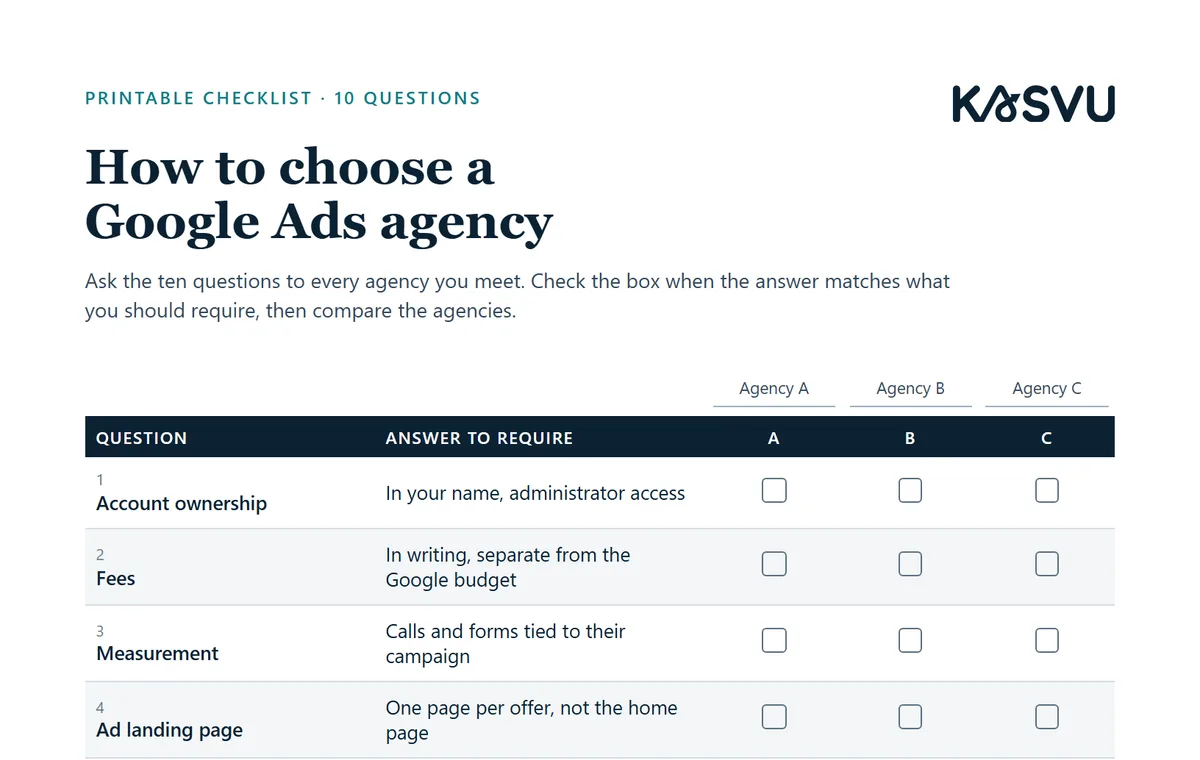
A vague answer counts as a “no.” Download the checklist (PDF), check the box when the answer matches what you should require, and ask for written answers about the account, the fees and the end of the contract.
Sources
- Google, Third-party policy (management fees, reports, misleading claims) · consulted November 12, 2026
- Google Ads Help, how to become a Google Partner or Premier Partner · consulted November 12, 2026
- Google Ads Help, about optimization score · consulted November 12, 2026
- Google Ads Help, language targeting (September 2026 change) · consulted November 12, 2026
- Charter of the French Language, s. 58 (LégisQuébec) · updated to August 12, 2026
- Kasvu, Google Ads benchmarks for Quebec 2026 (open data) · DOI 10.5281/zenodo.24145432
The author
François PainchaudFrançois’s LinkedIn profileFrançois Painchaud has managed Google Ads campaigns since 2014. He founded Kasvu, based in Montreal, which builds advertising campaigns and custom applications for small businesses in Quebec and the rest of Canada.
Our Google Ads agency